.png)
2025 Taxes, 2026 Markets: Planning in a Noisy Year
Updated: Mar 10

By Kevin Kull, CFA®, MBA, Financial Advisor (LinkedIn)
2025 Income Taxes and 2026 Stock Market Update
As we move through 2026, two perennial topics are once again top-of-mind for investors: income taxes and the stock market. While neither tends to inspire joy, both play a critical role in long-term financial outcomes. The good news? With thoughtful planning, neither has to be a surprise.
Below, is a practical update on 2025 tax considerations and a brief stock market overview, along with planning opportunities worth discussing this year.
2025 Income Taxes: Familiar Rules, Important Nuances
From a structural standpoint, the federal income tax system in 2025 looks familiar. The U.S. continues to use a progressive tax system, where income is taxed in layers rather than all at once at the highest rate.
Understanding Marginal vs. Effective Tax Rates
One of the most common sources of confusion is the difference between marginal and effective tax rates:
Marginal tax rate: The rate applied to the next dollar of income earned.
Effective tax rate: Total tax paid divided by total income.
For example, moving into a higher tax bracket does not mean all income is suddenly taxed at that higher rate—only the portion above the threshold. This distinction is essential when evaluating bonuses, retirement distributions, or Roth conversion decisions.
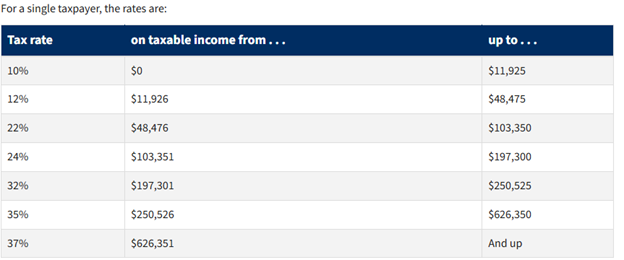
Source: Internal Revenue Service (IRS), irs.gov

Source: Internal Revenue Service (IRS), irs.gov
Key Tax Planning Areas to Review in 2025-2026

1. Capital Gains and Investment Income
Investment income remains a major driver of tax outcomes for many clients:
Long-term capital gains (assets held longer than one year) are taxed at preferential rates (0%, 15%, or 20%), depending on income.
Short-term capital gains are taxed at ordinary income rates.
Net Investment Income Tax (NIIT) of 3.8% may apply to higher-income households.
Planning consideration: Managing the timing of gains and losses can significantly affect after-tax returns. Tax-loss harvesting remains a valuable tool, especially during periods of market volatility.

2. Retirement Account Contributions and Distributions
Retirement planning and tax planning are inseparable:
Traditional IRA and 401(k) contributions may reduce current taxable income.
Roth contributions do not provide a current deduction but offer tax-free growth and withdrawals (subject to rules).
Required Minimum Distributions (RMDs) continue to apply beginning at age 73 for many retirees.
Planning consideration: Strategic Roth conversions—particularly in lower-income years or before Required Minimum Distributions (RMDs) begin—can help manage lifetime tax exposure and reduce future required distributions.

3. The SALT Deduction and Itemizing Decisions
The state and local tax (SALT) deduction cap remains a factor for many households, particularly those in higher-tax states. For some clients, this continues to limit the benefit of itemizing deductions.
Planning consideration: Bunching charitable contributions or utilizing donor-advised funds may help maximize deductions in certain years while smoothing charitable giving over time. *
Why Taxes and Markets Should Be Viewed Together
While taxes and markets are often discussed separately, some of the most effective planning happens when they are considered together.
Examples include:
Rebalancing portfolios in a tax-efficient manner.
Coordinating investment sales with income levels.
Managing retirement withdrawals to control marginal tax brackets.
Aligning charitable giving with appreciated assets.
Over time, after-tax returns—not just market returns—are what truly matter.
Stock Market Update: 2026 (So Far)
The 2026 stock market has entered the year like someone who promised to “take it easy” and then immediately signed up for CrossFit. U.S. equities have been volatile but are still marginally higher, fueled by resilient consumers, stubbornly optimistic earnings forecasts, and investors who still believe the Federal Reserve will eventually ride in on a white horse and cut rates. Inflation hasn’t disappeared, but it’s at least stopped shouting and is now muttering in the corner, which Wall Street is choosing to interpret as “good news.”
I believe private credit and AI disruption have been the two main subjects that have kept a lid on the market. While there will probably be some defaults & markdowns for some private credit funds, we don’t see any systemic risk in the private credit market. Also, in listening to many of the quarterly conference calls, most companies are using AI to enhance their business rather than be made obsolete by AI as the media has portrayed.
Overall, 2026 started with cautious optimism: not full champagne mode, but at least a polite golf clap. Investors remain watchful, caffeinated, and emotionally prepared for anything—which, historically, means they are likely unprepared. The key is to stick to your long-term investment plan and not get distracted by the daily media hysteria.
Final Thoughts: Planning Beats Predicting
Neither tax laws nor markets move in straight lines. However, disciplined planning, diversification, and proactive tax management can help reduce uncertainty and improve outcomes.
As always, we encourage clients to:
Review their tax situation annually
Coordinate investment and tax strategies
Revisit retirement income plans as circumstances change
If you have questions about how these considerations apply to your specific situation, we welcome the conversation.

Kevin Kull, CFA®, MBA
Financial Advisor, brings nearly two decades of investment expertise, having managed trust portfolios for a large regional bank before advising high-net-worth clients at top private wealth firms. Now at Ascend Advisory, his keen market insights and strategic approach help clients navigate uncertainty and seize long-term growth opportunities.
*Donations are irrevocable charitable gifts. The sponsoring organizations maintaining the fund have ultimate control over how the assets in the fund accounts are invested and distributed. Donor Advised Funds donors do not receive investment returns. The amount ultimately available to the Donor to make grant recommendations may be more or less than the Donor contributions to the Donor Advised Fund. While annual giving is encouraged, the Donor Advised Fund should be viewed as a long-term philanthropic program. Tax benefits depend upon your individual circumstances. You should consult your Tax Advisor. While the operations of the Donor Advised Fund and Pooled Income Funds are regulated by the Internal Revenue Service, they are not guaranteed or insured by the United States or any of its agencies or instrumentalities. Contributions are not insured by the FDIC and are not deposits or other obligations of, or guaranteed by, any depository institution. Donor Advised Funds are not registered under federal securities laws, pursuant to exemptions for charitable organizations.
Wells Fargo Advisors Financial Network did not assist in the preparation of this report, and its accuracy and completeness are not guaranteed. The opinions expressed in this report are those of the author(s) and are not necessarily those of Wells Fargo Advisors Financial Network or its affiliates. The material has been prepared or is distributed solely for information purposes and is not a solicitation or an offer to buy any security or instrument or to participate in any trading strategy. Additional information is available upon request.
Wells Fargo Advisors Financial Network does not provide legal or tax advice.
5263079
